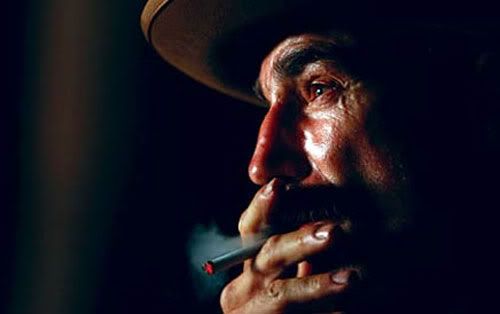
For the past few months the teasers and trailers for Ridley Scott's Prometheus have been drip fed to a salivating audience until the release of the official trailer this week, which looks mind blowing. Backed by a clever viral campaign featuring the character Peter Weyland from the Alien universe (played by Guy Pearce) giving a TED talk, the build up has been outstanding for Prometheus and the trailer has only bumped my anticipation up further. The trailer gives us plenty of fevered talking points but without allowing us to connect too much together, and there are tantalising glimpses of how Prometheus ties into Alien. For example the carving of what looks unmistakeably like the xenomorph into a temple wall, the eerily familiar shots of eggs which may or may not contain the forms of facehuggers, and the shot of what we assume to be the Space Jockey, fossilised into the throne which the crew of the Nostromo would go on to encounter in Alien. According to the most recent issue of Empire magazine, it has been tentatively suggested that the closing minutes of the film will thread Prometheus into the events of the 1979 sci-fi horror classic, and if that is so there is still the possibility that Giger's infamous monster will make an appearance. Questions abound until June 8 when the film is released, and I for one am charged with excitement about seeing how Mr Scott unravels the plot and attempts to capture the imagination of audiences the same way he did in 1979.
My Blog List
Popular Posts
-
A favourite among many TZ aficionados, Nightmare at 20,000 Feet is memorable for starring a young William Shatner, and being one of the mos...
-
Many who have followed the career of Quentin Tarantino would attest that his last great film dates back over a decade ago to 1997’s slic...
-
Monsters, along with District 9 and Moon is another recent reminder of how rich a genre the Sci-Fi is. I expect there to be allegorical ...
-
I thought this was an excellent, superbly crafted thriller with a strong ensemble of performances and a really fascinating attempt to s...
-
To open up my Twilight Zone marathon, a familiar parable about a genie in a lamp. Arthur Castle is a pawnbroker struggling to pay the ...
-
Danny Boyle's latest is a real showstopper. Following the relative conventionality of his recent output (Slumdog Millionaire, 127 Ho...
-
William Friedkin heaped praise on this film calling it 'maybe the best cop movie ever made', and I can understand why. As far as...
-
Over the next few weeks and months I'll be (re)visiting Rod Serling's classic series to coincide with the remastered release o...
-
As both character and franchise, James Bond's cinematic legacy is one of the most famous and quite potentially infinite, at this poin...
-
To portray an historical figure as hallowed and significant as the 16th President of America, Abraham Lincoln, would seem to be the most...
Total Pageviews
Wednesday, 21 March 2012
The Prometheus Trailer
For the past few months the teasers and trailers for Ridley Scott's Prometheus have been drip fed to a salivating audience until the release of the official trailer this week, which looks mind blowing. Backed by a clever viral campaign featuring the character Peter Weyland from the Alien universe (played by Guy Pearce) giving a TED talk, the build up has been outstanding for Prometheus and the trailer has only bumped my anticipation up further. The trailer gives us plenty of fevered talking points but without allowing us to connect too much together, and there are tantalising glimpses of how Prometheus ties into Alien. For example the carving of what looks unmistakeably like the xenomorph into a temple wall, the eerily familiar shots of eggs which may or may not contain the forms of facehuggers, and the shot of what we assume to be the Space Jockey, fossilised into the throne which the crew of the Nostromo would go on to encounter in Alien. According to the most recent issue of Empire magazine, it has been tentatively suggested that the closing minutes of the film will thread Prometheus into the events of the 1979 sci-fi horror classic, and if that is so there is still the possibility that Giger's infamous monster will make an appearance. Questions abound until June 8 when the film is released, and I for one am charged with excitement about seeing how Mr Scott unravels the plot and attempts to capture the imagination of audiences the same way he did in 1979.
Wednesday, 14 March 2012
The Twilight Zone: Nightmare at 20,000 Feet
A favourite among many TZ aficionados, Nightmare at 20,000 Feet is memorable for starring a young William Shatner, and being one of the most thrilling episodes of all 5 series. Bob is a recently discharged sanitorium patient returning to the original scene of his mental breakdown aboard a plane, which happened over a year ago. His sanity supposedly cured, it is immediately jeopardised when he thinks he has seen something on the wing of the plane, but whenever he accosts someone to look, it mysteriously disappears. Set amidst a storm, the episode is a masterclass in suspense from the Twilight Zone's frequent contributor, Richard Matheson (author of I Am Legend), and the dichotomy between madness and sanity is played brilliantly by Shatner, whose character is so convinced he has seen something, but fears the possibility of being accused of insanity and having a mental breakdown again, thus fulfilling a recurring nightmare.
Friday, 17 February 2012
Maine to host International Mustache Film Festival
As a prelude to the international Mustache Film Festival in Maine, USA, and a proud wearer of a mustache myself I thought I'd include a portfolio of my favourite movie 'taches in all their glorious forms. The festival will feature short films featuring a main character with a mustache, or a mustache oriented storyline. As Michael Caine in the Cider House Rules might say, 'Good luck you bristly kings of New England!'


I am sure I have ommitted many great uppper lip adornments, contributions are welcome!

I am sure I have ommitted many great uppper lip adornments, contributions are welcome!
Tuesday, 3 January 2012
Waltz with Bashir
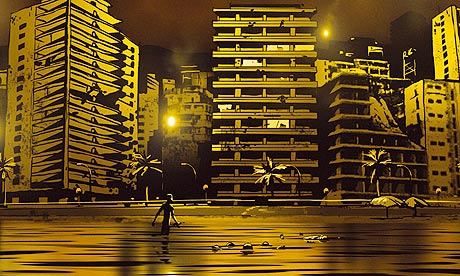
A documentary based on the massacres of Sabra and Shatila during the Lebanese war, Waltz with Bashir is a powerful, unique example of cinema acting as a medium for memory and self-reflection. The documentary follows its director, Ari Folman, in his search to recover the memories which had vanished about his time serving in the Israeli military, during which he had witnessed but could not recall the massacres. He interviews various soldiers who served with him and are the only witnesses who can confirm that he was present at that horrific event, and in narrative sequence, his memory eventually begins to unravel through the probing of his comrades'. It is highly intimate film-making made even more complicated by its situation around a war atrocity and told from an Israeli perspective, but it is nonetheless a fascinating immersion in Folman's personal quest to recover a defining moment of his past. Many of the memories of his interviewees are plagued with recurring dreams and nightmares about their experiences of the war, and articulates the irremovable mark war leaves upon the minds of its participants, and the nature of memory as a shifting filter which cannot fully process events quite as they are happening, or happened. In a wider sense the film engages with the effect of trauma upon the memory and the dis-associative effect between the witness and the event, and this is where the decision to use animation instead of real life footage is striking, apt, and provocative. It acts as a metaphor and a visual filter for Folman's memory, which is a form of representation itself, in the sense that it is an imagination of his history rather than a clear re-enactment of events, precisely because he could not remember them. Memory also becomes a politicised concept around events as inhumane and tragic as the Lebanese massacres, and it has not gone unnoticed that the film skirts around the Israelis' acknowledgement of responsibility over the genocide - the denial of memory in some ways might be interpreted as a defence mechanism, or a circumvention of guilt. Refusing to remember is sometimes an act with a deeply political agenda.
The animation also suggests a kind of hybrid documentary style, a new way of merging the real with the cinematic - a clash which is emphasised powerfully at the end when the film finally segues into real footage of the aftermath of the massacres. It is a startling change from the jaundiced but beautiful dreamscapes of the animation and it hits like a sledgehammer, leaving the visual residue of murdered bodies firmly in your mind. Rarely has a documentary film challenged its own medium to produce such a startling effect, and it is Folman's innovative decision which makes the film one of the greatest documentary films to have ever been made. While there are political wranglings over Waltz with Bashir, the essential examination of the atrocities of war and the physical and mental destruction produced by it is undeniably powerful.
Labels:
Animation,
Ari Folman,
Documentary,
Israel,
Lebanon,
Sabra,
Shatila,
Waltz with Bashir
Monday, 12 December 2011
The Twilight Zone: The Shelter
'Those people are our neighbours.'
This episode is one of the most terrifying ever written for the Twilight Zone - and there isn't a supernatural element in it. Precisely what makes it so disturbing is that the scenario Serling poses seems to be all too possible, and was possible in the Cold War era of the atomic bomb.
The episode opens with the celebration of the local doctor Bill Stockton, played by Larry Gates; a gathering of nuclear families and the exchange of normality and pleasantries, soon to be broken by a radio broadcast warning of UFOs converging on America. As panic sets in, each of the families leave to retreat to their homes and gather supplies. But the good doctor has something the other families do not - a bomb shelter. The other families plead with the doctor to let them in, but he refuses and events quickly turn nasty as the veneer of normality observed at the opening dinner quickly evaporates.
This 'exercise' as Serling likes to call it is one of his most powerful studies of human nature. The episode examines what happens when humanity is faced with its extinction, and Serling's answer is a troubling, pessimistic one. The families turn on each other with startling, uncivilised ferocity and the imperative becomes not just to survive, but to destroy others to live. Ugly prejudices rise to the surface; pointedly the suppressed xenophobic discourses of post-War America are directed at one of the characters described as a 'semi-American' by one of the men and his wife, who moments before were so amiable. Eventually two of the men decide to destroy the shelter door and they succeed seconds before another announcement is made, declaring the UFOs as harmless satellites.
What happens here is another disturbing idea: the families want to return to normal. The husband who barely minutes before had assaulted the 'foreigner', Marty, defends himself by protesting his fear of death, and Marty himself suggests a party despite the racial and physical abuse he has suffered. They all want a celebration - a performance of normality - apart from the doctor, who is appalled by what he has witnessed, and who suggests that normality, really, is the mob that almost tore itself apart to survive. Normality the episode suggests is a construct, a way of papering over the cracks and prejudices, joining in a false unity which evades the knowledge that you might not know your neighbours as well as you think, and that put in the right (or wrong) situation, they would destroy you to preserve their own lives. It is only the doctor who was prepared for the very possibility of a nuclear or bomb attack - and the disruption of normality -, and acknowledges that he might well have seen the neighbours in their true colours. The resonance of the episode is produced precisely as Serling forewarns: it is unsettlingly close to home, to the neighbours you may not fully know.
This episode is one of the most terrifying ever written for the Twilight Zone - and there isn't a supernatural element in it. Precisely what makes it so disturbing is that the scenario Serling poses seems to be all too possible, and was possible in the Cold War era of the atomic bomb.
The episode opens with the celebration of the local doctor Bill Stockton, played by Larry Gates; a gathering of nuclear families and the exchange of normality and pleasantries, soon to be broken by a radio broadcast warning of UFOs converging on America. As panic sets in, each of the families leave to retreat to their homes and gather supplies. But the good doctor has something the other families do not - a bomb shelter. The other families plead with the doctor to let them in, but he refuses and events quickly turn nasty as the veneer of normality observed at the opening dinner quickly evaporates.
This 'exercise' as Serling likes to call it is one of his most powerful studies of human nature. The episode examines what happens when humanity is faced with its extinction, and Serling's answer is a troubling, pessimistic one. The families turn on each other with startling, uncivilised ferocity and the imperative becomes not just to survive, but to destroy others to live. Ugly prejudices rise to the surface; pointedly the suppressed xenophobic discourses of post-War America are directed at one of the characters described as a 'semi-American' by one of the men and his wife, who moments before were so amiable. Eventually two of the men decide to destroy the shelter door and they succeed seconds before another announcement is made, declaring the UFOs as harmless satellites.
What happens here is another disturbing idea: the families want to return to normal. The husband who barely minutes before had assaulted the 'foreigner', Marty, defends himself by protesting his fear of death, and Marty himself suggests a party despite the racial and physical abuse he has suffered. They all want a celebration - a performance of normality - apart from the doctor, who is appalled by what he has witnessed, and who suggests that normality, really, is the mob that almost tore itself apart to survive. Normality the episode suggests is a construct, a way of papering over the cracks and prejudices, joining in a false unity which evades the knowledge that you might not know your neighbours as well as you think, and that put in the right (or wrong) situation, they would destroy you to preserve their own lives. It is only the doctor who was prepared for the very possibility of a nuclear or bomb attack - and the disruption of normality -, and acknowledges that he might well have seen the neighbours in their true colours. The resonance of the episode is produced precisely as Serling forewarns: it is unsettlingly close to home, to the neighbours you may not fully know.
Labels:
America,
Ethics,
Morality,
Neighbour,
The Twilight Zone
Saturday, 26 November 2011
The Twilight Zone: Eye of the Beholder
I promised a follow up to my Twilight Zone run down a while ago, and after a long procrastination I present one of the all time greats, Eye of the Beholder.
The episode opens in a hospital with a lady whose face is entirely bandaged, and we learn is undergoing some sort of treatment for what we assume to be a hideous, ostracising deformity. But it becomes apparent we cannot see the faces of the doctor and the nurses either, theirs in silhouette or their bodies turned away. The cinematography and mise-en-scene used to achieve this is some of the finest in any of the series of the Twilight Zone, the lighting perfectly utilised to obscure faces in darkness, and low angles employed deftly to create an ominous sense of concealment. That we do not see a face until the end of the episode is stylistically and thematically intertwined, and without spoiling anything, it has to the greatest reveal in the show's history. The problem with reviewing this episode is precisely that I refuse to give away the ending, but I shall nonetheless expand on the themes it touches.
As you might have guessed, the episode is built around philosophical principle 101: 'Beauty is in the eye of the beholder', an ageless principle which is relevant as ever today, but so resonant in contemporary America when both the fear and discursive necessity of conforming or being 'normal' was prevalent in society. Elsewhere in the episode we see television screens with a Stalin or Hitler-esque dictator ranting to the people about the need to conform within a state, and the bandaged woman's doctor frequently refers to her deformity in reference to the state and the measures taken over people with her condition. There are disturbing echoes of ethnic cleansing, genocide, and ghettoisation, and the episode becomes an indictment of the way in which discrimination is in many cases state sponsored, and marginalisation sanctioned in pursuit of an oppressive conformist state model. It is Serling at his very best; moral, political, but subtle and clever without being heavy handed. It is the combination of these elements that makes the best Twilight Zone episodes, and compels me to watch them years after they are supposed to have dated.
Labels:
Conformity,
Critique,
Eye of the Beholder,
Philosophy,
Politics,
Rod Serling,
State,
The Twilight Zone
Saturday, 22 October 2011
Drive
Drive is a wonderfully minimalist title, and one which not only describes, but encapsulates the very existence of Ryan Gosling's vacant, ghostly driver, whose cogito ergo sum as he imperatively puts it is, 'I drive.' The film opens with 'The Driver' assisting a robbery as a getaway driver in most probably the coolest opening to a film in recent memory, and later it is revealed he daylights as a stunt driver and is poised to become a racing driver under the patronage of a local garage owner, Shannon. However, there is mob interest in the form of Albert Brooks' menacing Bernie Rose, and the driver's life soon veers off course into a web of indebted money and murder. Notice the several driving metaphors I'll be using here - as many have interpreted the film, Drive is a modern continuation of the existentialist road movie: life is a drive, albeit without the sentimental chaff about twists and turns.
But that is exactly what happens to Gosling's driver, and it takes on a much more disturbing path. His straight shooting driver only knows one thing, and has rigidly defined principles: on getaway drives he gives 5 minutes to get in and out, anything longer and they're on their own. He resembles to an extent Robert de Niro's Neil McCauley in Michael Mann's Heat, whose discipline is never to get attached to anything that he can't walk out on 'if you can't see the heat around the corner', and who is a similarly cold character. And the comparison doesn't stop there, as both men inhabit a visually cold environment with coldly murderous characters, as with Albert Brooks' ostensibly calm but murderous mobster. When the driver gets involved in the murky business of debt and blood money, his principles are thrown out the window, his life is ripped apart and he reacts with a psychosis comparable to that of Travis Bickle or Patrick Bateman. It is tantamount to trauma for the driver, and Ryan Gosling plays the switch from passive observer to avenging angel with a superbly disturbing modulation in performance. The explosions of violence that attend to his path of vengeance are genuinely shocking, and despite protestations by some viewers of gratuity, it is entirely part of the driver's character, whose spectrum of morality is so confused and polarised that he can only respond to injustice with the most excessive retribution. The film itself is split into two halves, as the second half is so in contrast with the dreamy lethargy of the first that it should be understood as a deliberate and masterful control of atmosphere by Nicolas Winding Refn. His direction is fresh if indebted partly to other directors such as Michael Mann, and with any justice, he should be duly nominated come awards season.
The extreme stylisation of the film from its neo-noirish visuals to its synth 80s throwback soundtrack also swathes it in a mood of dreaminess, and as the driver's life descends into disarray the stylisation serves to represent the psychotic fantasy he has entered. In one unnerving, brilliant slow motion sequence the driver visits the diner to revel in the last moments of his next target, Ron Perlman's Jewish gangster, his face concealed by a blank rubber mask he uses for stunt driving. That he uses the mask is also wonderfully ironic, in that the expression Ryan Gosling's driver wears for the majority of the film is immovably blank. The face seems but a mask for the driver, who is surely crumbling inside.
Subscribe to:
Posts (Atom)