My Blog List

Popular Posts

Total Pageviews

Monday, 11 June 2012

Prometheus


I had genuine faith (please dont mention the irony) that Ridley Scott's return to the genre that defined his early career would yield something special, if not a classic, at least a thought provoking film that could stand on its own as one we might appreciate in years to come like Alien or Blade Runner. Lofty expectations, but that's just the problem - Prometheus cannot shake the lustre of what has gone before with its predecessors,  Alien and Aliens. Either way, measured on its own or with reference to the Alien canon, it falls down very early on and never manages to recover.

For starters the very opening of the films destroys the mystique that the original Alien sustained masterfully. The mysterious Space Jockey encountered in the original film which posed so many questions and theories is immediately revealed in the first few frames as a porcelain skinned alien, essentially humanoid in appearance. With all of the possibilities and the iconic work of Giger as a template, it is disappointing to find out straight away that beneath that ornamental, elephantine mask of the Space Jockey, is an anaemic, oversized human. Furthermore, the Promethean moment where the Space Jockey consumes the dark liquid and kick starts the evolution of mankind I felt sucked a strong element of discovery out of the plot. Immediately the who is taken away and we're left with just the why. The why is fundamentally more interesting because of the notions of God, human agency etc. but at the same time I didn't want to know so early on who the creators, or 'engineers', are. What made Alien so brilliant is that you never know who or what the xenomorph is until much later in the film. The reveal turns out to quick and unimpressive after all that has gone before.

As others have already said, Prometheus also suffers from a severe lack of narrative direction, tonal consistency and intelligent character development. I understood perfectly that the film was meant to be an interrogation on the origins of mankind and the nature and existence of God, but this gets lost amidst a chain of inexplicable plot diversions and incidences that left me completely incredulous by the final quarter of the film. Noomi Rapace's Elizabeth Shaw, a believer in God and divine creation is drawn to the answers posed by meeting the makers of humanity, but the significance and magnitude of this theme is diluted through being interspersed with action and gory set pieces, as well as a remarkably unintelligent script. Only in the last twenty minutes or so does it seem that the scriptwriters remember to make an attempt at following through on the grand questions of creation and/or teleology, and ultimately there is no payout. What cheapens it even further is that with Shaw's departure with David to meet the maker (or the maker's maker) to understand why mankind was targeted for destruction the idea seems to have been so sow the seeds for a sequel, whilst in the meantime expecting the audience to be contented with a distinct lack of closure. There are very occasionally some great lines, mainly spoken by Michael Fassbender's David about the nature of humanity and the relation between creator and created, but these are overwhelmed by the constant shifts in focus and the tendency to revisit the tropes of the original Alien universe, only this time a lot less subtly. The shifty company plant/android sub-narrative returns, but we've seen it all before with Ash and Bishop, and Charlize Theron's Vickers seems to be almost completely redundant; Ripley, er Shaw gets pregnant with an alien; and the scriptwriters make the fatal attempt of trying to cross the gritty character development of Alien with the machismo posturing of the Aliens marines. The result is lines like 'I'm a geologist! I love rocks!', and a complete apathy to the gruesome fate accorded to the entire crew, save for the only interesting characters, Shaw and David. Logan Marshall-Green's Holloway is a thoroughly dislikeable, arrogant prick who I couldn't take seriously as a scientist, Sean Harris is not much better as Fifield, and Rafe Spall's Milburn does possibly the dumbest thing you can do in a Sci-Fi/Horror film when he invites a pre-formed facehugger to get intimate with him the only way a facehugger knows how. I was also bugged by how nonchalant most of the crew apart from Shaw seem to be about their amazing discovery - if I were a scientist having discovered an alien life form with the same strand of DNA I'd be astounded - but you just don't get that feeling from the characters.

Out of the rest Idris Elba is watchable as the straight shooting A to B captain, but no one is free from shoddy writing as his character suddenly becomes privy to the increasingly forced philosophical meanderings which later motivate Shaw to take the Engineers' ship to their planet of origin. The writing, by and large, makes absolutely no sense - after Shaw escapes after being sedated for quarantine, why does no one seem to pursue her? She undergoes the whole surgical procedure without anyone breaking in and even when she leaves to discover in a ridiculous plot twist that Weyland is aboard the Prometheus, none of them seem shocked about what has happened to Shaw, who is covered in blood. Also, why doesn't she just flee after realising that she was going to be sedated in cryo by the company so the alien she was impregnated with would be transported back to Earth? Moments of intrigue such as when they bring the Engineer out of cryo stasis are dashed when it turns out the Engineer is just as malevolent as the xenomorph and would rather kill than communicate about their designs on humanity. In reiteration, it's that inability to stay in one genre that weighs the film down - the monster movie horror moments undermine the more cerebral intentions and as a result the explosions of viscera dominate, to the detriment of taking the questions of grand design seriously.

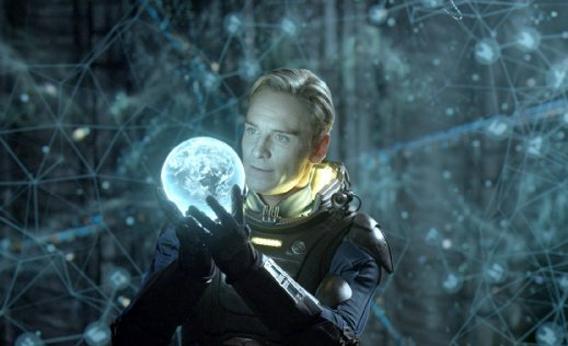
For all of this however, the one shining, saving grace is Michael Fassbender as David. As with the previous androids he garners our distrust in him with memories of Ash from the first Alien, yet we sympathise with the glimpses of humanity he displays; his questioning of his makers, his appearance of innocence, and his imitations of humanity. The dependent relationship he and Shaw have upon one another by the film's end is genuinely touching, and thinking about it the film would have benefited from more scenes between Fassbender and Rapace. On his own, Fassbender is the most compelling presence on screen, communicating curiosity, duplicity, and suggesting the potential for synthetic consciousness Scott probed originally in Blade Runner. It really is a marvellous, fascinating performance from one of the finest actors of his generation.

Prometheus is a case of a brave, interesting concept collapsing under the weight of a botched execution. It strives to provoke and ask compelling questions about humanity, but this is a lost amidst aimless narrative direction and a confused script. It has some memorable moments, exemplary visuals, and Fassbender's performance is particularly worth revisiting, but unfortunately it cannot hold the elements of intelligent science fiction and horror together to create a coherent whole.

Wednesday, 21 March 2012

The Prometheus Trailer


For the past few months the teasers and trailers for Ridley Scott's Prometheus have been drip fed to a salivating audience until the release of the official trailer this week, which looks mind blowing. Backed by a clever viral campaign featuring the character Peter Weyland from the Alien universe (played by Guy Pearce) giving a TED talk, the build up has been outstanding for Prometheus and the trailer has only bumped my anticipation up further. The trailer gives us plenty of fevered talking points but without allowing us to connect too much together, and there are tantalising glimpses of how Prometheus ties into Alien. For example the carving of what looks unmistakeably like the xenomorph into a temple wall, the eerily familiar shots of eggs which may or may not contain the forms of facehuggers, and the shot of what we assume to be the Space Jockey, fossilised into the throne which the crew of the Nostromo would go on to encounter in Alien. According to the most recent issue of Empire magazine, it has been tentatively suggested that the closing minutes of the film will thread Prometheus into the events of the 1979 sci-fi horror classic, and if that is so there is still the possibility that Giger's infamous monster will make an appearance. Questions abound until June 8 when the film is released, and I for one am charged with excitement about seeing how Mr Scott unravels the plot and attempts to capture the imagination of audiences the same way he did in 1979.

Wednesday, 14 March 2012

The Twilight Zone: Nightmare at 20,000 Feet


A favourite among many TZ aficionados, Nightmare at 20,000 Feet is memorable for starring a young William Shatner, and being one of the most thrilling episodes of all 5 series. Bob is a recently discharged sanitorium patient returning to the original scene of his mental breakdown aboard a plane, which happened over a year ago. His sanity supposedly cured, it is immediately jeopardised when he thinks he has seen something on the wing of the plane, but whenever he accosts someone to look, it mysteriously disappears. Set amidst a storm, the episode is a masterclass in suspense from the Twilight Zone's frequent contributor, Richard Matheson (author of I Am Legend), and the dichotomy between madness and sanity is played brilliantly by Shatner, whose character is so convinced he has seen something, but fears the possibility of being accused of insanity and having a mental breakdown again, thus fulfilling a recurring nightmare.

Friday, 17 February 2012

Maine to host International Mustache Film Festival

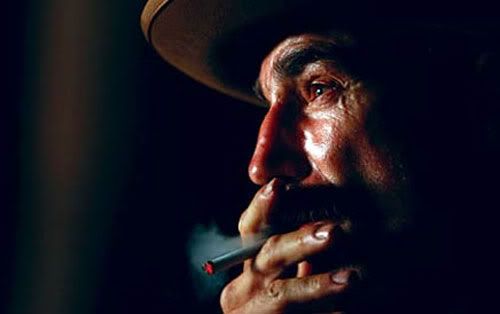
As a prelude to the international Mustache Film Festival in Maine, USA, and a proud wearer of a mustache myself I thought I'd include a portfolio of my favourite movie 'taches in all their glorious forms. The festival will feature short films featuring a main character with a mustache, or a mustache oriented storyline. As Michael Caine in the Cider House Rules might say, 'Good luck you bristly kings of New England!'


I am sure I have ommitted many great uppper lip adornments, contributions are welcome!

Tuesday, 3 January 2012

Waltz with Bashir


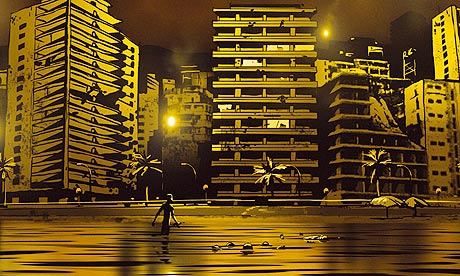
A documentary based on the massacres of Sabra and Shatila during the Lebanese war, Waltz with Bashir is a powerful, unique example of cinema acting as a medium for memory and self-reflection. The documentary follows its director, Ari Folman, in his search to recover the memories which had vanished about his time serving in the Israeli military, during which he had witnessed but could not recall the massacres. He interviews various soldiers who served with him and are the only witnesses who can confirm that he was present at that horrific event, and in narrative sequence, his memory eventually begins to unravel through the probing of his comrades'. It is highly intimate film-making made even more complicated by its situation around a war atrocity and told from an Israeli perspective, but it is nonetheless a fascinating immersion in Folman's personal quest to recover a defining moment of his past. Many of the memories of his interviewees are plagued with recurring dreams and nightmares about their experiences of the war, and articulates the irremovable mark war leaves upon the minds of its participants, and the nature of memory as a shifting filter which cannot fully process events quite as they are happening, or happened. In a wider sense the film engages with the effect of trauma upon the memory and the dis-associative effect between the witness and the event, and this is where the decision to use animation instead of real life footage is striking, apt, and provocative. It acts as a metaphor and a visual filter for Folman's memory, which is a form of representation itself, in the sense that it is an imagination of his history rather than a clear re-enactment of events, precisely because he could not remember them. Memory also becomes a politicised concept around events as inhumane and tragic as the Lebanese massacres, and it has not gone unnoticed that the film skirts around the Israelis' acknowledgement of responsibility over the genocide - the denial of memory in some ways might be interpreted as a defence mechanism, or a circumvention of guilt. Refusing to remember is sometimes an act with a deeply political agenda.

The animation also suggests a kind of hybrid documentary style, a new way of merging the real with the cinematic - a clash which is emphasised powerfully at the end when the film finally segues into real footage of the aftermath of the massacres. It is a startling change from the jaundiced but beautiful dreamscapes of the animation and it hits like a sledgehammer, leaving the visual residue of murdered bodies firmly in your mind. Rarely has a documentary film challenged its own medium to produce such a startling effect, and it is Folman's innovative decision which makes the film one of the greatest documentary films to have ever been made. While there are political wranglings over Waltz with Bashir, the essential examination of the atrocities of war and the physical and mental destruction produced by it is undeniably powerful.

Monday, 12 December 2011

The Twilight Zone: The Shelter

'Those people are our neighbours.'


This episode is one of the most terrifying ever written for the Twilight Zone - and there isn't a supernatural element in it. Precisely what makes it so disturbing is that the scenario Serling poses seems to be all too possible, and was possible in the Cold War era of the atomic bomb.

The episode opens with the celebration of the local doctor Bill Stockton, played by Larry Gates; a gathering of nuclear families and the exchange of normality and pleasantries, soon to be broken by a radio broadcast warning of UFOs converging on America. As panic sets in, each of the families leave to retreat to their homes and gather supplies. But the good doctor has something the other families do not - a bomb shelter. The other families plead with the doctor to let them in, but he refuses and events quickly turn nasty as the veneer of normality observed at the opening dinner quickly evaporates.

This 'exercise' as Serling likes to call it is one of his most powerful studies of human nature. The episode examines what happens when humanity is faced with its extinction, and Serling's answer is a troubling, pessimistic one. The families turn on each other with startling, uncivilised ferocity and the imperative becomes not just to survive, but to destroy others to live. Ugly prejudices rise to the surface; pointedly the suppressed xenophobic discourses of post-War America are directed at one of the characters described as a 'semi-American' by one of the men and his wife, who moments before were so amiable. Eventually two of the men decide to destroy the shelter door and they succeed seconds before another announcement is made, declaring the UFOs as harmless satellites.

What happens here is another disturbing idea: the families want to return to normal. The husband who barely minutes before had assaulted the 'foreigner', Marty, defends himself by protesting his fear of death, and Marty himself suggests a party despite the racial and physical abuse he has suffered. They all want a celebration - a performance of normality - apart from the doctor, who is appalled by what he has witnessed, and who suggests that normality, really, is the mob that almost tore itself apart to survive. Normality the episode suggests is a construct, a way of papering over the cracks and prejudices, joining in a false unity which evades the knowledge that you might not know your neighbours as well as you think, and that put in the right (or wrong) situation, they would destroy you to preserve their own lives. It is only the doctor who was prepared for the very possibility of a nuclear or bomb attack - and the disruption of normality -,  and acknowledges that he might well have seen the neighbours in their true colours. The resonance of the episode is produced precisely as Serling forewarns: it is unsettlingly close to home, to the neighbours you may not fully know.

Saturday, 26 November 2011

The Twilight Zone: Eye of the Beholder

I promised a follow up to my Twilight Zone run down a while ago, and after a long procrastination I present one of the all time greats, Eye of the Beholder.

The episode opens in a hospital with a lady whose face is entirely bandaged, and we learn is undergoing some sort of treatment for what we assume to be a hideous, ostracising deformity. But it becomes apparent we cannot see the faces of the doctor and the nurses either, theirs in silhouette or their bodies turned away. The cinematography and mise-en-scene used to achieve this is some of the finest in any of the series of the Twilight Zone, the lighting perfectly utilised to obscure faces in darkness, and low angles employed deftly to create an ominous sense of concealment. That we do not see a face until the end of the episode is stylistically and thematically intertwined, and without spoiling anything, it has to the greatest reveal in the show's history. The problem with reviewing this episode is precisely that I refuse to give away the ending, but I shall nonetheless expand on the themes it touches.


As you might have guessed, the episode is built around philosophical principle 101: 'Beauty is in the eye of the beholder', an ageless principle which is relevant as ever today, but so resonant in contemporary America when both the fear and discursive necessity of conforming or being 'normal' was prevalent in society. Elsewhere in the episode we see television screens with a Stalin or Hitler-esque dictator ranting to the people about the need to conform within a state, and the bandaged woman's doctor frequently refers to her deformity in reference to the state and the measures taken over people with her condition. There are disturbing echoes of ethnic cleansing, genocide, and ghettoisation, and the episode becomes an indictment of the way in which discrimination is in many cases state sponsored, and marginalisation sanctioned in pursuit of an oppressive conformist state model. It is Serling at his very best; moral, political, but subtle and clever without being heavy handed. It is the combination of these elements that makes the best Twilight Zone episodes, and compels me to watch them years after they are supposed to have dated.