My Blog List
Popular Posts
-
From celebrated director Guillermo del Toro and co-author Chuck Hogan comes The Strain, a modern day take on the vampire myth that combines ...
-
Coppola's other film from 1974, The Conversation is about the life of Harry Caul, a mercenary surveillance expert who begins to doubt th...
-
To portray an historical figure as hallowed and significant as the 16th President of America, Abraham Lincoln, would seem to be the most...
-
I had genuine faith (please don ’ t mention the irony) that Ridley Scott's return to the genre that defined his early career would ...
-
The trademark Coen palette of oddness and the unnatural natural seems to be at its most apposite in A Serious Man, as Jewish professor Larry...
-
For the past few months the teasers and trailers for Ridley Scott's Prometheus have been drip fed to a salivating audience until th...
-
As a prelude to the international Mustache Film Festival in Maine, USA, and a proud wearer of a mustache myself I thought I'd include a ...
-
With each rewatch the weak special effects are not any less jarring, but this is still a bold, relentlessly bleak horror where the real ...
-
First of all, I haven't read the graphic novel, despite being within feet of it, and I was wondering whether to postpone my viewing unti...
-
For a film about John Dillinger, the charismatic and audacious one man crime wave, Public Enemies is a remarkably understated biography of h...
Total Pageviews
Saturday, 22 October 2011
Drive
Drive is a wonderfully minimalist title, and one which not only describes, but encapsulates the very existence of Ryan Gosling's vacant, ghostly driver, whose cogito ergo sum as he imperatively puts it is, 'I drive.' The film opens with 'The Driver' assisting a robbery as a getaway driver in most probably the coolest opening to a film in recent memory, and later it is revealed he daylights as a stunt driver and is poised to become a racing driver under the patronage of a local garage owner, Shannon. However, there is mob interest in the form of Albert Brooks' menacing Bernie Rose, and the driver's life soon veers off course into a web of indebted money and murder. Notice the several driving metaphors I'll be using here - as many have interpreted the film, Drive is a modern continuation of the existentialist road movie: life is a drive, albeit without the sentimental chaff about twists and turns.
But that is exactly what happens to Gosling's driver, and it takes on a much more disturbing path. His straight shooting driver only knows one thing, and has rigidly defined principles: on getaway drives he gives 5 minutes to get in and out, anything longer and they're on their own. He resembles to an extent Robert de Niro's Neil McCauley in Michael Mann's Heat, whose discipline is never to get attached to anything that he can't walk out on 'if you can't see the heat around the corner', and who is a similarly cold character. And the comparison doesn't stop there, as both men inhabit a visually cold environment with coldly murderous characters, as with Albert Brooks' ostensibly calm but murderous mobster. When the driver gets involved in the murky business of debt and blood money, his principles are thrown out the window, his life is ripped apart and he reacts with a psychosis comparable to that of Travis Bickle or Patrick Bateman. It is tantamount to trauma for the driver, and Ryan Gosling plays the switch from passive observer to avenging angel with a superbly disturbing modulation in performance. The explosions of violence that attend to his path of vengeance are genuinely shocking, and despite protestations by some viewers of gratuity, it is entirely part of the driver's character, whose spectrum of morality is so confused and polarised that he can only respond to injustice with the most excessive retribution. The film itself is split into two halves, as the second half is so in contrast with the dreamy lethargy of the first that it should be understood as a deliberate and masterful control of atmosphere by Nicolas Winding Refn. His direction is fresh if indebted partly to other directors such as Michael Mann, and with any justice, he should be duly nominated come awards season.
The extreme stylisation of the film from its neo-noirish visuals to its synth 80s throwback soundtrack also swathes it in a mood of dreaminess, and as the driver's life descends into disarray the stylisation serves to represent the psychotic fantasy he has entered. In one unnerving, brilliant slow motion sequence the driver visits the diner to revel in the last moments of his next target, Ron Perlman's Jewish gangster, his face concealed by a blank rubber mask he uses for stunt driving. That he uses the mask is also wonderfully ironic, in that the expression Ryan Gosling's driver wears for the majority of the film is immovably blank. The face seems but a mask for the driver, who is surely crumbling inside.
Thursday, 1 September 2011
Source Code
I saw Source Code a few months ago on its cinema release and my positive impression of it hasn't changed. The sophomore feature of Duncan Jones, director of Moon, Source Code only consolidates an impressive emerging pattern, and now directorial trademark of intelligently produced, original science fiction cinema. It is a very different film but it shares its DNA with Moon in this sense.
It works successfully on many levels. On its surface level as an action film, it fully exploits its setting on board a Chicago bound train; the minimal space, and the paranoia accompanying modern travel is effectively reproduced and amplifies the film's central premise - what would you do with only 8 minutes left to live ? This 8 minutes as it transpires is the last memory of a passenger killed in a terrorist attack on the train, and is being used by Jeffrey Wright's mad scientist to recreate a scenario for Jake Gyllenhaal's captain Colter, who must re-experience these 8 minutes to work out who the bomber is in alternate reality before they set off a bigger dirty bomb in real time Chicago. This is the function of Source Code: to temporarily recreate the past in order to change the future. It's a genial science fiction concept which resonates on the planes of philosophy and morality while creating a different spin on the sci-fi staple of parallel universe theories.
Colter is sent back several times through Source Code to catch the bomber, which means we keep returning to the same environment. But it rarely becomes dull despite this, and there are plenty of twists and false starts to vary the deja vu setup. One sequence for example makes a clever riff on the paranoiac assumption that all terrorists are non-white Muslim suicide bombers. But there is also plenty going on between the sequences which give the film emotional clout and a core of human sensitivity to the film which was also present in Moon. Without giving too much away, Wright's Dr. Rutledge and Vera Farmiga's captain Goodwin reveal to Colter that he is an unwilling test subject for Source Code, and each time he returns he is both given and makes ultimatums which will have consequences on his own life. With Colter flitting back and forth between the Source Code and reality, he begins to invest himself more and more in his assumed identity and becomes increasingly attached to Michelle Monaghan's passenger Christina, while realising that he can use the parallel reality to find out about Colter's. It's all finely but superbly balanced, and Gyllenhaal gives a nuanced and multi-faceted performance of a man trapped in a limbo of emotional and even metaphysical sorts. Colter is a man forced to visit the great beyond several times through Source Code as he inhabits Sean Fentress' last moments, and Gyllenhaal perfectly conveys the psychological weariness of having to face death time and time again.
Akin to a Philip K. Dick story, Source Code is also a highly intelligent science fiction film which engages with the ethical implications of its imaginary technological invention, much like the classic Blade Runner, the excellent Minority Report, and indeed Jones' first film, Moon. It sets Source Code apart from simply being a thriller with a science fiction element, to a sophisticated mind bender which imagines the possible moral questions should something like 'Source Code' ever exist, and is expressed through the growing sympathy of Farmiga's Goodwin for Colter, and her increasing doubts about the morality of the project.
Satisfyingly, the film endeavours to follow its ideas of quantum physics through to conclusion in its ending, which seems to have split audiences, but I think works perfectly, and plays cunningly with a Hollywood genre cliche in the process. Although it may be the clinching moment for some who see it less favourably (or miss the point altogether), I see it as a brilliantly inventive coda and shows the film hasn't run out of ideas, even as the credits are about to roll.
Sunday, 28 August 2011
RocknRolla
I'm so glad my prejudice against Guy Ritchie gets to stay intact, because this is surely one of the worst films I've ever seen. At first I really did want to give this film the time of day, but after 10 minutes I quickly realised this was his usual fare, only amplified and worse, itself carrying some ugly prejudice of its own. It manages to bounce racism and homophobia for (non-existent) laughs through Tom Hardy's coming-out-scene and a copious and nonchalant use of the word 'immigrant' in pretty much every scene with Tom Wilkinson, who pantomimes his way through every scene as a hammy sub Bob Hoskins cockney gangster, and subsequently becomes an unintentional parody of a character type we've seen many tedious times before. I like Tom Wilkinson, but I must admit he gives way at times to chewing scenery - just see his performance in the risible television series 'The Kennedys' for recent reference. But with RocknRolla the dialogue is so excruciatingly contrived there's not much more to work with than self-parody. Ritchie's insistence on dividing the English language into Cockney and not is the funny thing about the film, along with his supposedly original idea of having a painfully unsubtle Roman Abramovich clone move in on his territory as a play on the possibility of Russian gangsters moving in on London gangster territory. And the final seal that we're watching a dreadful comedy is the idea that the Abramovich clone gets into a mob war with Wilkinson's goons over a missing painting, commandeered by Toby Kebbel's titular RocknRolla, Johnny Quid. Frankly, it doesn't get sillier than that. Performances hit the usual one note Ritchie demands, i.e., wisecracking Cockney hostility, although Tom Hardy, Toby Kebbel and Mark Strong do the best they can.
Monday, 22 August 2011
Man in the Bottle
To open up my Twilight Zone marathon, a familiar parable about a genie in a lamp. Arthur Castle is a pawnbroker struggling to pay the bills and unable to abandon his charity for a poor elderly lady, who one day brings him a seemingly worthless bottle to pawn. A genie inhabits this bottle, which appears to Arthur to grant him 4 wishes - but warns him of the consequences.
Although this episode is a fairly predictable narrative and the moral message takes the oft heard form, 'be careful what you wish for', it nonetheless has one very memorable moment when Luther Adler's Arthur wishes to become the leader of a modern country 'who cannot be voted out of office' - only to become Adolf Hitler at the end of the Second World War. It becomes unintentionally funny when Adler, adorned with the fuhrer's moustache, turns round and realises his mistake - 'I'm Hitler, I'm in a bunker !" - but it remains a great illustration of what man might do were he given four wishes by a genie. John Ruskin also gives a good performance as the foreboding genie, quietly awaiting Arthur's catastrophic wishes but granting them all the same. The admonition 'be careful what you wish for' seems to occur frequently in The Twilight Zone, and to invoke psychoanalytic theory, Serling engages with the notion that humans can never achieve or realise their desires without provoking consequences or debts (To be consumed or ridiculed accordingly).
Next: A classic of the Twilight Zone pantheon involving a lot of bandages. A lot.
Thursday, 18 August 2011
The Twilight Zone Revisited
Over the next few weeks and months I'll be (re)visiting Rod Serling's classic series to coincide with the remastered release of all 5 seasons of The Twilight Zone on DVD half a century since the seminal show first aired. Its legacy is unmistakeable. A theme tune younger generations recognise decades after the programme ended and associate with horror, science fiction, the mysterious and unexplained. The trademark clipped delivery of Rod Serling's opening caveat at the start of every episode. And some of the most memorable moments, and (oft imitated) twists in television history.
For its time, The Twilight Zone was a groundbreaking series, critically acclaimed, and earned Serling multiple Emmys for his consistently superb writing. But it was much more than a science fiction television programme, weaving contemporary political and social issues, morality and philosophy into the fabric of many of its episodes. As a genre, science fiction is extremely fertile as a vehicle for allegory, and The Twilight Zone exploited the possiblities of the supernatural, super-scientific and hypothetical to invert the way we look at the world. After some episodes we are left even wondering whether the real world is, actually, the Twilight Zone.
The famous opening describes the Twilight Zone as 'the middle ground between light and shadow, between science and superstition, and it lies between the pit of man's fears and the summit of his knowledge'. It is a ground of moral grey areas, double edged situations and paradoxes which forces us to examine whether people are as moral as they believe they are. In the postwar, ideologically conformist America of the 1950s and 60s, the Twilight Zone was a bold programme which used its science fiction form to subtly challenge contemporary politics and social prejudices. It interrogated the human condition and examined its hypocrisies, ironies and superficialities, and didn't shy away from politics in its critique of the state as a vehicle for totalitarianism.
I'll be reviewing my favourite episodes as well as those held in high esteem by fans and critics, so stay tuned while I navigate you all on a trip, through the Twilight Zone ...
Labels:
Culture,
Morality,
Philosophy,
Politics,
Rod Serling,
Science Fiction,
Society,
Television,
The Twilight Zone
Friday, 29 July 2011
30 Days of Night
The mythical lore of das vampyr has been incarnated on celluloid countless times dating back to Shreck's portrayal of the Nosferatu, regarded to be the definitive interpretation of the living dead; through to Bigelow's twist of a vampire western, Near Dark, and Coppola's Dracula, spattered with blood and the obligatory camp, although the majority of these renditions fail to convey a less than romanticised view of the stark brutality of a vampire's carnal existence - the breed of bloodsucker to be found in 30 Days of Night shares little with its predecessor, albeit the immaculate dress sense, and is as far removed from humanity as possible.
The clan of vampires, led by a passive, but imposing Danny Huston, communicates among its number lingually through screeching utterances in vampire tongue, and it is one such instance of the excellent use of sound to invoke fear, an aspect which is sometimes as visceral as the visual brutality - the sequence in which the town is rapidly decimated is one that lingers indelibly on the mind, and the combination of the three primary colours, in this case sanguineous red, black and white impress on the eyes a bleakness and desolation that accentuates the nightmarish situation. What really gives the film bite, is the extremity of the violence; one sequence involving the vampire's ploy to draw out the survivors culminates in the torment of and eventual murder of the woman being used as bait, that is deeply unsettling to watch, and possibly requisite of another visit to the censors.
Disturbing and perturbing, 30 Days of Night is one of the most effective horror films of recent times, and gnaws at the jugular for the entirety of its screen time.
Labels:
30 Days of Night,
Danny Huston,
Horror,
Josh Hartnett,
Melissa George,
Vampires
Black Swan Cinema Review
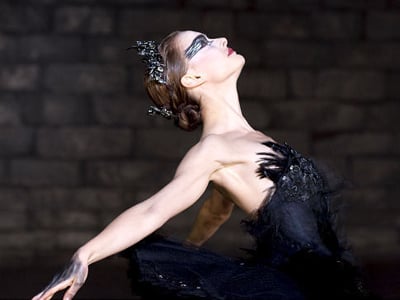
An outstanding film with a tremendous performance from Natalie Portman as Nina, the obsessive ballerina torturing herself in pursuit of the ultimate performance of both the White Swan, and the Black Swan. Aronofsky's unique auteur style transposes amazingly from The Wrestler - where previously he captured the grit and degradation of amateur wrestling the ballet stage is a shadowy mirror world, the Freudian subtext hanging deliciously and maliciously in the air. Certain sequences might appear to tip the subtle fantasy into generic horror but they're constructed with an indeed balletic panache and nightmarish-ness that it's as exciting as it is psychologically sinister. Vincent Cassel is also very good as the demanding director, and Mila Kunis suitably lascivious and alluring as Lily, Nina's nemesis and feared usurper. Portman deserves all the plaudits she gets as this is by far her best ever performance; the dedication she put into the role is brutally visible, her performance a mirror of Nina's gruelling pursuit of perfection.
Subscribe to:
Posts (Atom)